


B2B marketing hasn’t gotten any easier.
You’re being asked to do more with less. Sales cycles are longer. Buying committees are bigger. And the tactics that worked just a few years ago? They’re falling flat.
Sound familiar?
You’re not alone—and you’re not doing it wrong. You’re just playing in a system that wasn’t built for how buyers actually behave today.
That’s why we made this playbook.
It’s for B2B marketing leaders who are done with the spray-and-pray approach and want to create something smarter:
A content engine that positions your subject matter experts as industry authorities, building trust and awareness with the 95% of your audience that’s not yet in-market.
We’ll cover:
- Why traditional lead gen is breaking down—and what to do instead
- A 9-pillar framework for building an effective thought leadership strategy
- How to build a high-performing content engine with your subject matter experts (without overloading them)
- The best distribution channels for long sales cycles—and how to use them
- The metrics that matter most for proving impact and earning leadership buy-in
Why Traditional Lead Gen Doesn’t Work Anymore
A while back, a CMO at a cybersecurity firm broke down her LinkedIn spend for me: $50k/month on lead gen and $5k/month on brand awareness. She was stressed because her pipeline was drying up.
Here’s the thing: when you spend almost your entire budget chasing the 5% of buyers who are in-market today, you ignore the 95% who will be in-market over the next 6-24 months.
So if you’re only focusing on pushing gated whitepapers and webinars to drive MQLs, you’re setting yourself up for failure.

A report from Metadata proved this point by analyzing $37M ad spend on lead gen campaigns. The result: only 0.2%(!) of MQLs converted to closed-won deals.
That means you need 500 leads to acquire a new customer, which is painfully inefficient given the average cost per lead of $123.
So why has traditional lead gen become so ineffective?
Because buyer behavior has significantly changed over the past few years:
1. Buyers now prefer to educate themselves at their own pace, diving deep into content to find solutions to their challenges (without giving up their email address or phone number in a lead form).
2. The buying journey has become more dynamic and unpredictable, with dark social channels (like Slack groups, WhatsApp chats, and private communities) playing a crucial role in how buyers gather information.
3. Buying committees have nearly tripled in size over the past decade, leading to longer sales cycles.

The Cost of Bad Content
The decline of traditional lead gen has left many teams scrambling to fill the gap with more content. But without the right strategy, this often leads to high volumes of low-impact content that does more harm than good.
Bad content isn’t just ineffective. It’s an expensive problem that erodes trust, damages your credibility, and pushes potential buyers away.
Consider this example:
A CIO is navigating cybersecurity threats. He comes across a whitepaper titled “The CIO’s Playbook for Data Security.”
Although the title sounds promising, it turns out to be superficial, filled with obvious tips like “use multi-factor authentication” and “conduct regular backups.”
It’s instantly clear these “insights” are completely obvious and shallow, ignoring the deeper strategic challenges buyers actually face.
Over the next few months, the CIO comes across other content pieces from the same company; the webinar clip feels like a sales pitch, and the articles are irrelevant to their actual challenges.
And just like that, you’ve lost their trust.

Getting better results from your content isn’t about producing more content—it’s about producing the right content. And that starts with a clear understanding of what an effective content program actually looks like.
Content’s Real Job in B2B: Build Trust, Not Traffic
80% of B2B buyers already have a shortlist before they ever speak to sales. And when that moment comes, the only thing that matters is:
– Did they remember you?
– Were you in their consideration set?
– Did your content build enough trust and familiarity over time?
Great content marketing builds trust at scale, drives top-of-mind awareness, and positions your company as the industry authority.
But most marketing teams struggle to build and run a content engine that does just that.
In my conversations with dozens of CMOs, marketing directors, and content leads, the same challenges keep coming up:
- There’s no documented content strategy or distribution plan, so they default to random acts of content that don’t align with business goals.
- They’re struggling to stand out; their content sounds like everyone else’s.
- Their content isn’t getting much engagement on LinkedIn and their website, and they’re unsure how to reach the right audience.
- There’s a lack of thought leadership and a strong point of view, because their subject matter experts (SMEs) either don’t have time to write or aren’t involved in the content process.
If you want your content to build trust and drive results, you need to get the strategy right from the start.
How to Build a Thought Leadership Content Strategy
A high-performing content engine isn’t built on guesswork. It’s built on research, structure, and strategic intent with what you create, who it’s for, and how you distribute it.
Here’s the 9-pillar framework we use for our clients:

1. Customer Research
The best thought leadership content starts with deep customer insights. Interview your 10+ best customers and review at least 15 recent sales calls to uncover the real pain points, triggers, objections, and language your buyers actually use. This ensures your content speaks to what matters to them—not just what sounds good internally.
2. Competitor Analysis
To stand out, you need to know what others are already saying. Analyze your competitors’ content to understand what’s resonating—and more importantly, what’s missing. Spotting those blind spots gives you the opportunity to say something fresh, useful, and different.
3. Industry Analysis
What trends are shaping your market? What are analysts, influencers, and thought leaders talking about? Use this information to create relevant content and signal that your brand understands the bigger picture. Great thought leadership doesn’t just react to change—it anticipates it.
4. Content Themes
Now that you’ve gathered insights from customers, competitors, and the market, define your core themes. These themes should reflect your buyers’ top challenges, your company’s strengths, and the broader conversation happening in your space. Themes act as the strategic foundation for all future content—they keep your message focused and consistent.
5. Topics
Break your themes into specific, relevant topics. These are the questions your buyers are already asking and the challenges they’re actively trying to solve. Prioritize the topics that sit at the intersection of buyer needs and your company’s unique point of view.
6. Unique Insights & SME Selection
This is what separates commodity content from true thought leadership. What do you want your brand to be known for? What hard-won insights, proprietary frameworks, or lived experiences can you share that no one else can? The key is choosing the right subject matter experts—people with deep expertise, strong opinions, and real-world experience. Identify them early and build a process to consistently tap into their insights.
7. Content Formats
Match the message to the medium. Start by analyzing historical performance data to understand which formats resonate most with your audience. These could be LinkedIn posts, articles, videos, carousels, webinars, podcasts, infographics, and more. Use those insights to focus your efforts and build a repeatable process for creating high-quality content in the formats that drive the highest engagement.
8. Distribution Plan
Distribution isn’t an afterthought—it’s what determines whether your content gets seen or ignored. No matter how strong your content is, it won’t make an impact if your audience never sees it. Define a clear distribution plan that covers both organic channels (like employee LinkedIn profiles, newsletters, and communities) and paid amplification (such as LinkedIn Thought Leader Ads).
9. KPI Framework
Define what success looks like from the start. Don’t rely on vanity metrics like traffic or impressions. Focus on the signals that show your content is building trust, driving meaningful engagement, and influencing pipeline. I’ll share examples of these in the next chapter.
From Strategy to Execution: Building Your Thought Leadership Content Engine
Now that you have a solid foundation in place, it’s time to build the content engine.

Step 1: Interview Your SMEs
One of the biggest roadblocks to thought leadership programs is the lack of involvement from subject matter experts. Not because they’re unwilling, but because they’re already stretched thin. Most marketing teams don’t have a system that makes collaboration easy.
Too often, the process looks like this:
→ Marketing asks an SME to write an article or join a webinar
→ The SME pushes back or ghosts you entirely
→ Everyone scrambles last minute to meet the deadline
It’s stressful for you and frustrating for them.
But it doesn’t have to be that way.
The most effective content engines remove the friction. They make it easy for SMEs to contribute without adding more work to their plate. That means having a repeatable process that respects their time and plays to their strengths.
Here’s the workflow we typically use with Leadwave clients:
Choose Topics and Select Interviewees
We usually focus on two topics per month. Guided by the content strategy, we plan six topics for each quarter. Each one is then matched with the most relevant SME from the marketing team.
Instead of casting a wide net across the entire company, we focus on identifying three or four SMEs who have deep expertise, strong opinions, and are open to sharing content on their LinkedIn profiles.
Why such a narrow focus?
Because consistency beats volume. When you rely on a small, committed group of SMEs, you can go deeper, not broader, allowing for sharper positioning, stronger narratives, and higher-quality content. You’re not starting from scratch every month with a new voice or perspective.
It also makes distribution dramatically more effective. A few SMEs posting consistently will outperform a dozen employees sharing LinkedIn content a few times a year. Repetition builds recognition, and familiar faces build trust.
And from a production standpoint, it keeps things way more focused. You’re not chasing ten people for input—you’re working closely with a few who understand the process, see the value, and are invested in the outcome.
The Interview Process
We schedule a monthly 1-hour interview with each selected SME.
Before every interview, we dive into research to understand the topic, the audience, and what makes this expert’s take uniquely valuable.
We then prepare and share a set of tailored interview questions in advance, so the SME knows what to expect and can come prepared.
During the session, we listen closely and go off-script when needed. The best insights always surface through follow-up questions. We push for clarity, challenge vague answers, and dig until we uncover customer stories and practical frameworks.
We record the session using Squadcast, a remote podcast studio that captures high-quality video and audio. This ensures everything is ready for both written content creation and video clip production.
Step 2: Create High-Impact Content
Once the SME interview is complete, the real work begins. We turn each interview recording into a set of engaging content assets that speak directly to your audience’s pain points and position your SME as the industry authority.
Here’s how we typically approach it:
Identify the Best Insights
We carefully review the interview recording and transcript to identify the most compelling soundbites, frameworks, and examples. These become the foundation for multiple content formats like articles, video clips, and LinkedIn posts.
Write a Long-Form Article
We usually start with an in-depth content asset: a bylined article, a POV piece, or a narrative-driven case study. It anchors the rest of your content, focuses on your SME’s perspective, and serves as the foundation for everything you repurpose later.
For example, here’s an article we ghostwrote for Abnormal AI’s VP of EMEA, where we also embedded video clips we produced (great for SEO!).
Produce Video Clips
From the recorded interview, we produce 4-6 short-form video clips. Each one is tightly edited around a single idea, includes subtitles and branding, and runs between 40 seconds and 1 minute 30 seconds: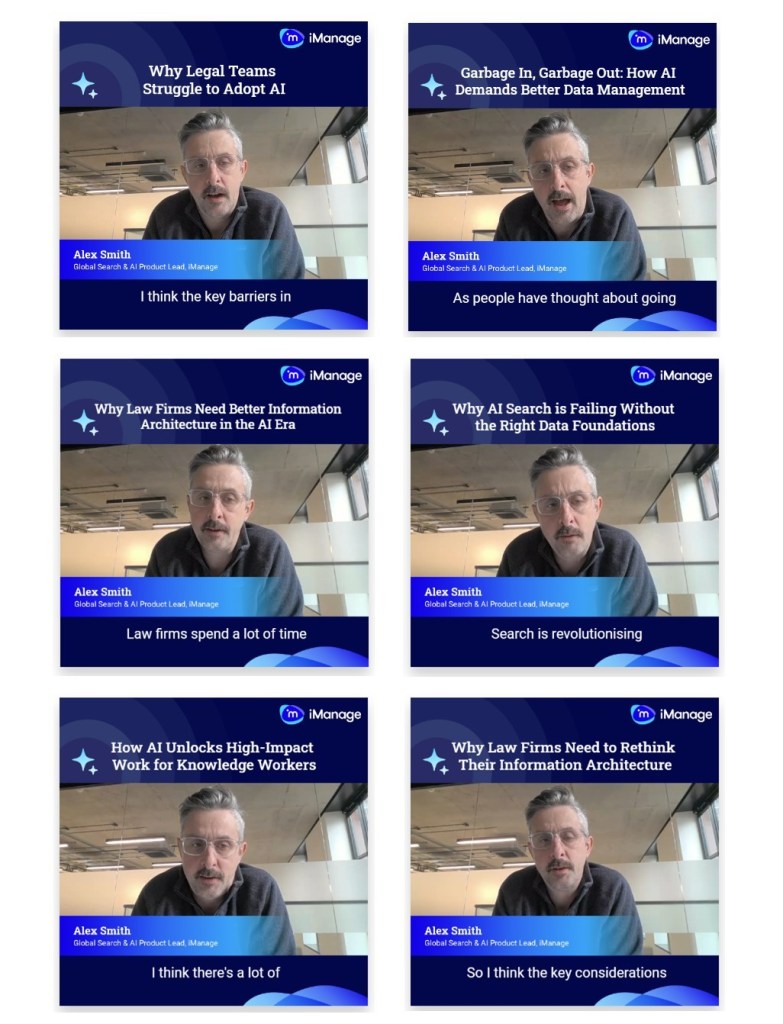
Write LinkedIn Posts
We turn the best takeaways into 8-10 LinkedIn posts with a strong point of view, a scroll-stopping hook, and clean formatting for maximum readability—then tie each one back to the full article and video clips.
Internal Review & Final Edits
The marketing team and the SME review the assets to ensure clarity, accuracy, and alignment. Once approved, the asset is added to the content library for scheduling and distribution.
Each content piece plays a role: the posts grab attention, the article delivers depth, and the clips showcase the SME’s voice—working together to maximize visibility, build trust, and reinforce the message across different channels.
Step 3: Distribution
For most B2B marketing teams, distribution is the biggest bottleneck.
A Marketing Director recently told me: “We’re sitting on so much unused content, it’s insane.”
They spend most of their time churning out content at lightning speed, then promote it with a couple of LinkedIn posts before jumping to the next project.
Why? Because the focus is almost always on creating net-new content instead of distribution.
At Leadwave, we flip that approach.
We treat distribution as a core part of the process so your best content doesn’t collect dust, but actually reaches your target audience in the right place, at the right time.
For most B2B companies, that place is LinkedIn.
Here’s what our typical distribution engine looks like:
Distribution Channel #1: Your Experts’ Personal LinkedIn Profiles
This is the most important distribution channel in your mix—and the one most teams overlook.
Why? Because people trust people more than logos. Personal profiles are far better at building trust and credibility than company pages, especially in long sales cycles where brand familiarity matters.
They also tend to get much better reach. From what we’ve seen with clients, posts shared from personal accounts often get 4–5x more reach than the exact same post on a company page. And with LinkedIn’s latest algorithm changes further reducing company page visibility, that gap is only growing.
Here’s a LinkedIn video clip we created for our client iManage, based on an interview with one of their subject matter experts, Alex Smith. He posted it on his personal LinkedIn, and it got some great traction—lots of likes, comments, and reshares.

That said, getting SMEs to post consistently is no easy task. They’re busy, and content usually isn’t top of mind.
Here’s a simple scheduling workflow we use with our clients to make it easy:
1. Once you’ve identified the 2–3 SMEs you’re going to work with, link their LinkedIn profiles to a scheduling tool like Buffer. This takes 2 minutes and only needs to be done once.
2. Interview them once a month and turn those sessions into articles, video clips, and LinkedIn posts.
3. After they’ve approved the content, schedule the assets directly to their profiles via Buffer. This saves a lot of time going back and forth.
BONUS TIP: Link any relevant long-form content like articles or whitepapers to roughly half of your LinkedIn posts. Even if LinkedIn limits reach on external links, the trade-off is worth it to send readers to long-form content.
Distribution Channel #2: LinkedIn Thought Leader Ads
Once your SMEs are publishing consistently, Thought Leader Ads are the natural next step.
They allow you to take your best-performing organic posts—the ones already resonating with your audience—and amplify them through paid promotion. But instead of running these as traditional company ads, you run them directly from your SMEs’ personal LinkedIn profiles.
Here’s what that looks like for our client iManage, who promoted Alex Smith’s LinkedIn post as a Thought Leader Ad:

You can tell this is a Thought Leader Ad by the “Promoted by iManage” label. Aside from that, it looks just like a regular LinkedIn post in your feed.
And that makes a huge difference. In long sales cycles, where trust and familiarity are everything, this Thought Leader Ad format consistently outperforms traditional brand ads.
Why? Because it doesn’t feel like an ad.
You’re not interrupting someone’s scroll with a pitch to “download an ebook.” You’re showing up in their feed with human, insight-driven content delivered by an expert. Overly salesy ads get skipped immediately. This doesn’t.
Here’s why Thought Leader Ads work so well:
– They feel native. These ads outperform traditional brand ads because they look like organic posts from real people. That authenticity drives much stronger results. Our clients often see high dwell times and CTRs over 8% (while typical LinkedIn campaigns sit at just 1%)—a strong signal that people aren’t just scrolling past, but stopping to engage with and consume the content.

– They build trust. Your SME becomes a familiar voice in the feed—not someone who shows up once a quarter with a gated asset.
– They scale efficiently. Instead of relying on organic reach, you can upload your target account list and reach the right decision-makers consistently and precisely.
BONUS TIP: When you run your LinkedIn post as a Thought Leader Ad, update it with a CTA such as offering a free strategy call. It’s a great way to capture in-market prospects.
Distribution Channel #3: LinkedIn Company Page
While personal profiles drive most of the reach and engagement, your company page still plays an important role in your content mix.
It’s your brand’s official voice, and it’s where people go when they want to learn more about your company. That makes it a key credibility touchpoint.
The goal isn’t to post daily or chase vanity metrics. It’s to use your company page to:
✅ Reinforce your point of view
✅ Showcase thought leadership from your SMEs
✅ Keep your presence consistent and strategic
The best part? You can usually repurpose the exact same posts you’ve created for your SMEs with just a few tweaks, so you get twice the reach and visibility. It’s one of the easiest ways to scale your output without burning more resources.
Here’s how iManage published Alex Smith’s LinkedIn video clip on their company page:

BONUS TIP: Always tag the SME in the company post so your audience can easily find and follow them. It’s a simple way to create more future touchpoints with your buyers.
Distribution Channel #4: Newsletter
Newsletters are often one of the most overlooked yet most valuable distribution channels in your toolkit.
Why? Because unlike social media, where reach depends on algorithms, newsletters go straight to your audience’s inbox. You’re not competing with a hundred other posts in the feed—you have a direct line to your readers.
And if they’ve subscribed to your newsletter, they want to hear from you.
Newsletters are the perfect channel to:
✅ Extend the reach of your SME content beyond LinkedIn
✅ Build a consistent narrative over time
✅ Stay top-of-mind with customers, prospects, and partners
✅ Drive traffic back to your site or content hub
For most clients, we repurpose each SME interview into a dedicated newsletter edition. It’s a simple but powerful way to get more value from the content you’ve already created.
Here’s how we usually do it:
1. Lead with a compelling insight or story
Start the newsletter with the most valuable takeaway from the SME interview or long-form article. This hooks the reader and sets the tone—whether it’s a surprising stat, a personal story, or a strong point of view.
2. Include one or two short video clips
Bring the SME’s voice and personality to life. These clips help humanize the message, build familiarity, and increase engagement—especially when paired with a quote or short summary for context.
3. Add helpful context and commentary
Don’t just drop in links. Explain why the insight matters, how it connects to broader industry trends, or what readers can take away from it. This gives the newsletter standalone value, even for those who don’t click through.
4. End with a clear call to action
Guide readers to the next step: whether it’s reading the full article, watching more clips, or exploring related content. The CTA should feel natural, not salesy, and be easy to follow. It’s a low-effort, high-impact way to reinforce your message and make sure your best content keeps working across channels.
Step 4: Measure What Matters
Once your thought leadership content engine is running, you’ll want to track its performance to understand what’s working, what’s not, and how content is driving real business outcomes.
Too often, marketing teams only focus on vanity metrics like traffic or impressions. These can be useful, but they’re just the starting point.
The real question is: is your content building trust, driving engagement, and creating opportunities?
I’ll walk through the metrics we track most often for video clips and LinkedIn posts, breaking them into two key categories: organic engagement and paid engagement.
Organic Engagement Metrics
These metrics help you measure how your content performs on personal LinkedIn profiles and company pages, and understand whether it’s resonating with the right audience.
Engagement
- Views: How many people saw the post or video?
- Likes & Reposts: Did it resonate?
- Comments: Did it spark conversation?
- Saves & Sends: How many people saved your post or shared it with others? (This is a brand new LinkedIn analytics feature!)


Audience & Reach
- Follower growth: Is your audience expanding over time?
- Profile views: Are people checking out your SME or company profile after engaging?
- Engagement from ICPs: Are the right buyers interacting with your content?
Qualitative Signals
- Inbound messages: Are people reaching out based on your content? Here’s a LinkedIn message I got from one of my prospects:

- Mentions / Tagging: Are others referencing your content or looping you into related conversations?
- Internal feedback: Are sales teams getting reactions from customers or prospects about your content?

Paid Engagement Metrics (Thought Leader Ads)
These are performance-focused metrics that help you understand how your paid Thought Leader Ads are scaling reach, influence, and pipeline impact. All of these metrics are available in your LinkedIn Ads dashboard.
Performance Metrics
- CTR (Click-Through Rate): How relevant is the content?
(For reference, our clients often see 5–10% CTRs—well above the LinkedIn brand ad average of 1%) - Dwell times: How long are people engaging with your post?
- Video watch time: Are people actually consuming the content, or just scrolling past?
Audience Quality
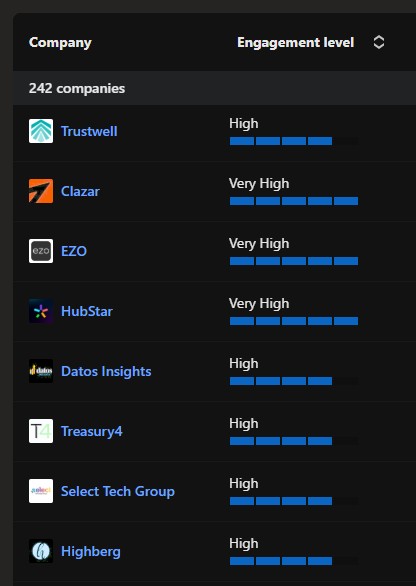
- Target account engagement: Which accounts are actively engaging with your ads? Here’s an example from our own campaign dashboard:

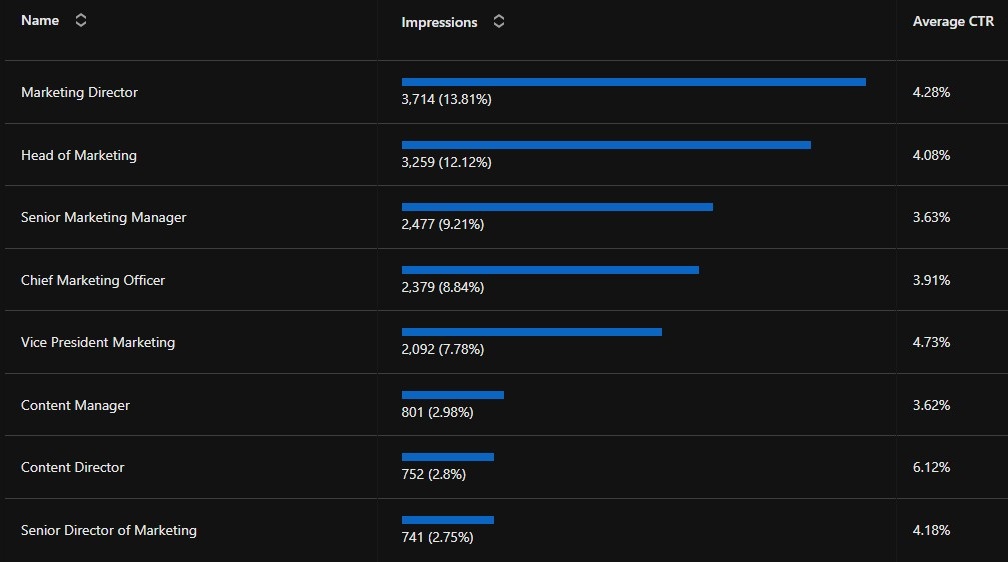
- ICP engagement: Are you reaching and engaging the right titles at the right companies? Here’s an example from our own campaign dashboard:

Conversion Signals
- Landing Page Clicks: Are people clicking on the CTAs in your posts?
- Time on page / scroll depth: Are they engaging with the page after clicking, or bouncing quickly?
- Booked calls: Are leads referencing the LinkedIn posts in the “How did you hear about us?” field?
Step 5: Analyze Your Data to Improve Your Content
Metrics matter most when they inform what you create next and how you improve your approach over time.
Use the data to see which topics resonate most with your audience, and double down on those for future SME interviews.
Look for patterns in which formats, narratives, and SME voices drive the strongest engagement from your ideal buyers.
If a post has high dwell time but low CTR, it may need a stronger hook.
If Thought Leader Ads with a certain SME consistently outperform, prioritize their perspective in upcoming campaigns.
Over time, these insights will shape what you create next, where you promote it, and how you refine your message for even better results.
Build Your Content Engine Today
The way B2B buyers discover, evaluate, and choose vendors has changed forever.
Traditional lead gen and random acts of content won’t get you there.
But you can build something different that compounds in value over time.
A thought leadership content engine isn’t just a marketing program. It’s a system for building trust at scale, shaping the narrative in your market, and positioning your brand as the go-to authority long before a buyer is in-market.
You now have the framework:
✅ A clear strategy built on real customer insight
✅ A way to tap into your internal experts without draining them
✅ A process for creating high-impact content from interviews with your experts
✅ A distribution plan that keeps your message in front of the right people
✅ A measurement approach that proves marketing’s role in driving pipeline
Start small: pick one or two SMEs, run a few interviews, and publish consistently for 90 days. Momentum will build faster than you think—then you can start adding more SMEs to your engine.
Do this right, and you’ll earn trust at scale with the 95% of your audience who aren’t in-market yet but already see you as the industry authority.
And guess what? When they’re ready to buy, you’ll be the first name they think of. That’s when the real magic happens for our clients:


Niels van Melick
CEO at Leadwave
Niels van Melick
CEO at Leadwave


